Industry solution

Textiles & Apparel Manufacturing

From approved sample to shipped carton, with every hand-off in view

Sample approvals, shade lots, line balancing, piece-rate pay, water and traceability, run by specialist products designed to work as one.

Products
8
Challenges
6
Concepts
15
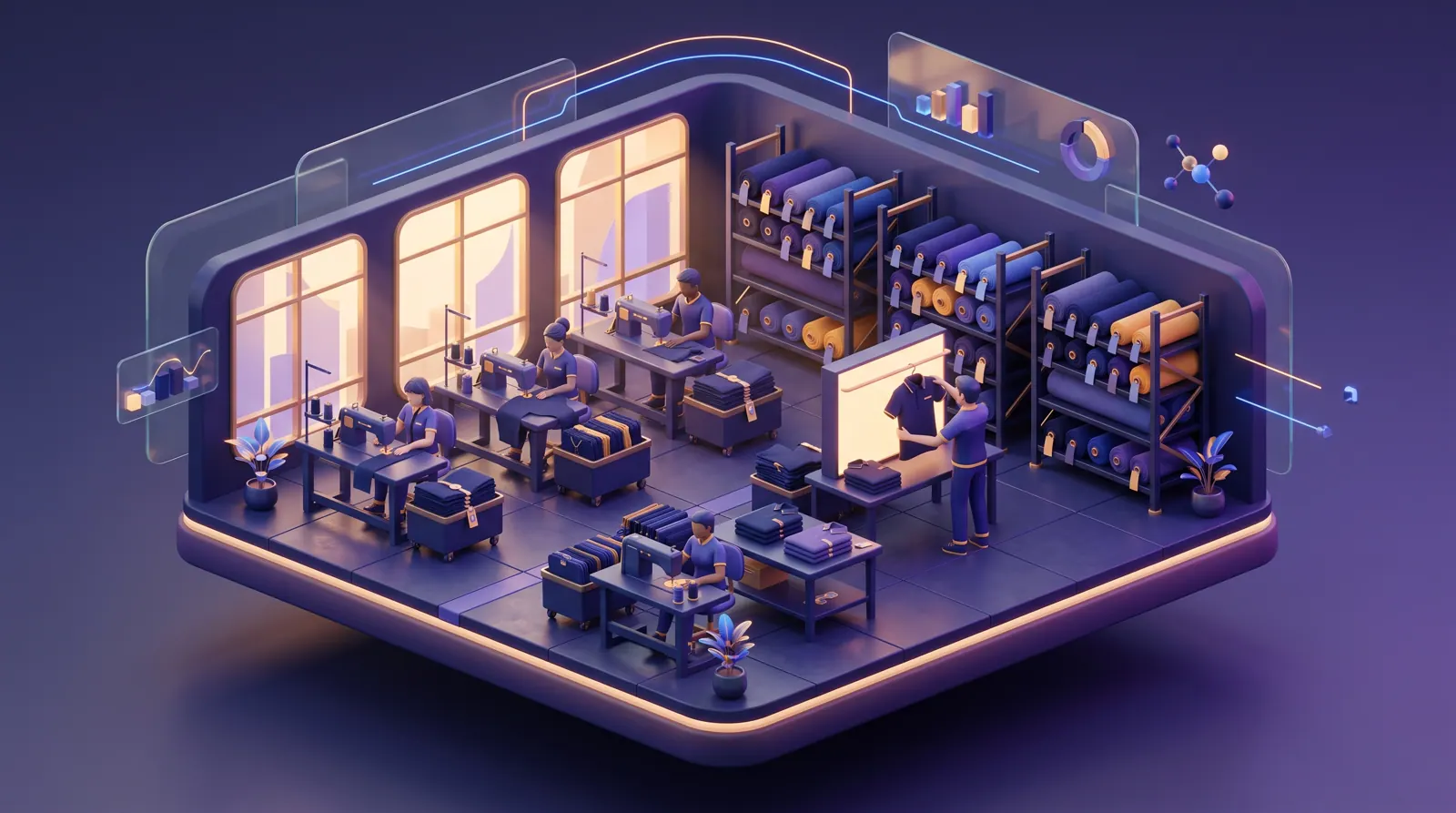
Garment sewing line with bundles of navy panels and a checker comparing shade beside dyed fabric rolls
ManufacturedOps(opens ManufacturedOps in a new tab)ArtistryBase(opens ArtistryBase in a new tab)CrewFoundry(opens CrewFoundry in a new tab)EcoImpactHub(opens EcoImpactHub in a new tab)MoveTheWheels(opens MoveTheWheels in a new tab)FluidGrids(opens FluidGrids in a new tab)BigConsole(opens BigConsole in a new tab)Botlit(opens Botlit in a new tab)

The problem

Why running a garment supply floor is hard right now

Garment exporters lose time and margin in the gaps: the sample room sews an old tech pack, rolls from three dye lots meet on one lay, bundle stubs decide pay, and a buyer's traceability request lands on spreadsheets.

A composite knitwear or woven exporter runs several businesses under one roof: knitting or weaving, a dye house, cutting, sewing lines, finishing and a shipping dock, often with outside mills and job-work units at peak. Each keeps its own records. Tech packs and sample comments live in email, roll inspections in a register, line output on hourly boards, pay on bundle stubs, meter readings on clipboards and shipping papers in the stores. Everyone is right about their own slice and blind to the rest.

Buyers ask for more on the same FOB price: shorter lead times, fewer sample rounds, clean final inspections, and now proof of where every order was made, down to the yarn, with water and energy per kilo and hours and wage records that stand up to a social audit. Margins are thin, the ex-factory date rarely moves, and a missed vessel usually means air freight at the factory's cost.

This page describes a solution concept: how specialist Burdenoff products are designed to pass these facts to one another on Burdenoff Workspaces, so a comment, a roll, a bundle or a meter reading becomes an action in the right hands. The products are pre-launch, and the hand-offs shown here describe how they are designed to work together.
Who this is for

  • Managing director or GM operations

    Holding ex-factory dates and buyer confidence on thin FOB margins, with one honest view of samples, lines, the dye house and compliance.

  • Merchandising head

    Moving every style through lab dips, fit and PP samples on the TNA calendar, and never letting a line sew to a superseded tech pack.

  • Quality assurance manager

    Catching shade and fabric faults before cutting, keeping end-line and final inspections clean, and answering buyer claims with evidence.

  • Industrial engineering and production head

    Balancing each line around its real bottleneck hour by hour, and knowing early when a line's pace puts the ex-factory date at risk.

  • HR, compliance and welfare manager

    Paying piece-rate crews correctly, keeping hours within limits, answering worker questions and walking into social audits with clean records.

  • Brand sourcing and compliance lead

    Seeing the facilities and certificates behind every order in one view, and water answers that trace back to meter readings, without chasing email.

A day in the life

The story behind the solution

A week at Tamarind Loop Knitwear

Tamarind Loop Knitwear knits, dyes, cuts and sews polos, tees and fleece for three leisurewear brands, with a dye house beside the knitting unit, three sewing floors and an outside embroidery unit it uses in peak weeks. Kavitha Raman runs operations. The biggest order on the floor is PO-4471, a navy pique polo for Linden & Moor, due ex-factory on October 30 to make its vessel. This is one ordinary, difficult week, and how the products on this page are designed to change it.

  1. Monday, 9:20 a.m.

    Comments on a sample made from the wrong version

    Merchandiser Farhan Qureshi opens an email from Johanna Weiss, the buyer's technical designer: photos of the pre-production (PP) sample for the LM-2244 rib henley, circled in red, and a note that collar height and chest grading changed in tech pack v4. The sample room made it from v3, the copy on the shared drive. The olive lab dip approval sits in another thread, the trim card waits on a new care label, and cutting is on the time and action calendar for next Monday.

    How this is solved: Approve the right sample against the right tech pack
  2. Tuesday, 7:40 a.m.

    Three dye lots on one lay

    At the end of Line 7, checker Priya Nair holds up a navy polo from PO-4471: the front panel is a shade lighter than the back. Monday's lays mixed rolls from three dye lots, and the rib collars from an outside mill were never compared with the body. Fabric QC had logged two rolls over the four-point limit in its register, but the rolls sat in the store in the order they arrived and the cutting master took what was nearest.

    How this is solved: Keep mixed dye lots and faulty rolls out of the cutting room
  3. Wednesday, 11:00 a.m.

    Line 7 is stuck at the placket

    Line 7 changed over to the polo on Monday with a target of 90 pieces an hour. It is making 50. Industrial engineer Thu Trang Nguyen walks the line with the hourly board: bundles are stacked in front of placket finishing, where one of its two regular operators is absent, while a skilled operator on hem is waiting for work. The planner's loading sheet still assumes the last style's efficiency, and PO-4471 must leave the factory on October 30.

    How this is solved: Balance the sewing line before the ex-factory date slips
  4. Thursday, 6:30 p.m.

    Why is my pay lower this week

    Line supervisor Joseph Mwangi is surrounded at shift end. Operators learning the new operations earned less this week, and Meena Krishnan asks why her pay is lower than last week's. The answer is in a stack of bundle stubs in the payroll office, where the clerk is also checking who is near the weekly hour limit and whether this week's minimum wage top-ups follow the same rule as last month's.

    How this is solved: Pay piece-rate crews correctly, and answer them when they ask
  5. Friday, 5:10 a.m.

    COD above the limit at the outlet

    After a night re-dyeing two navy batches that failed shade, the effluent treatment plant operator's lab result shows outlet chemical oxygen demand (COD) above the permit limit. He writes it in the register and calls dye house manager Selvam Arumugam. On Kavitha's desk, the buyer's environmental questionnaire asks for water, steam and electricity per kilo of fabric, and the answers sit on clipboards, in the boiler logbook and in dyeing program sheets.

    How this is solved: Water, steam and effluent per kilo, from the dye house's own meters
  6. Friday, 3:00 p.m.

    Where exactly was PO-4471 made

    Linden & Moor's compliance team asks for a traceability pack for PO-4471: the spinner, knitting unit, dye house and every facility that touched the polos, with the cotton origin declaration and the certificates behind the organic claim. They also ask whether any work went outside the disclosed facilities. In peak weeks the chest embroidery went to an outside unit, recorded only on delivery notes in the stores.

    How this is solved: Show a buyer where every order was made, down to the yarn

By the next Monday, Tamarind Loop has the same lines, the same dye house and the same buyers. What changes, in this concept, is that each problem arrives as a record in the right product, in front of the right person, while there is still time to act, and the buyer sees each order as it really is.

Challenges and how they are solved

6 problems, several products, one connected answer

Each challenge shows the problem as it happens, how the products are designed to hand work to each other, and the concepts that illustrate it. Share any challenge on its own.

Answers are in plain business terms. Choose Technical, or open any technical detail, to see how it works under the hood.

The problem

In most export factories a style's sample history is spread across courier parcels, email threads and whichever folder someone last saved to. Buyer comments return as marked-up photos plus a note about what changed in the latest tech pack, and the sample room may have worked from an older copy. Lab dips, print strike-offs and trim cards are each approved in their own thread, on their own timetable. Bulk dyeing waits on the lab dip, cutting waits on pre-production (PP) approval, the time and action (TNA) calendar keeps moving, and nobody can say with confidence which comments are closed and which spec the line should sew to.

What it costs

Every extra sample round eats days from a fixed ex-factory date, and a line that sews to a superseded spec turns into rework, a failed final inspection or a buyer claim.

How the products work together

ArtistryBase keeps every version of the tech pack and runs each lab dip and sample stage as a review, with the buyer's comments pinned to the exact spot on the photo and a recorded approval. FluidGrids is designed to send the approved shade to the dye house once the lab dip is signed off, and the approved spec and trim card to the cutting room after the pre-production sample.

How it works — technical detail

Technical detail

ArtistryBase is designed to hold each style as a work with immutable tech pack versions and typed assets, with the tech pack, measurement spec, lab dip scans, print artwork and trim card attached. Each stage, from lab dips and fit to size set and PP, is designed to run as a review round on a named version, with the buyer's technical designer pinning comments to the exact spot on the photo or strike-off and recording an approval (client approval links are on ArtistryBase's roadmap). When a lab dip round is approved, a FluidGrids automation is designed to send the approved lab dip to ManufacturedOps as the dye house's shade standard, so bulk dyeing can start. When the PP round is approved, it is designed to release the tech pack, measurement spec, trim card and open comments to the production order as released documents and clear the cut gate.

The outcome it is designed for

The merchandiser knows which spec is approved and which comments are still open, cutting starts on the approved version, and the line sews to the same documents the buyer signed.

The concepts behind it

The problem

Fabric reaches the cutting room from more than one source: the factory's own dye house in several dye lots, and outside mills whose rib, collars or fabric arrive with paper packing lists. Fabric QC inspects a sample of rolls on the four-point system and checks shade against the approved lab dip in a light box, but the results live in a register the store and cutting room rarely see. Rolls are shelved wherever there is space rather than by dye lot, and lays are built from whatever is at hand, so shading within a garment, or a collar that does not match the body, surfaces only at end-line inspection, after the whole lay has been cut and sewn.

What it costs

Shading within a garment is found at end-line or at the buyer's final inspection, when the only options left are recutting, a discount, a failed shipment or replacement goods by air.

How the products work together

Rolls from the factory's own dye house are designed to be recorded in ManufacturedOps with their dye lot, weight and width, while fabric and collars from outside mills are checked in roll by roll in MoveTheWheels. Each roll is compared with the approved lab dip and sorted into a shade group, and no lay mixes groups. Faulty rolls are held for re-dyeing or sent back.

How it works — technical detail

Technical detail

Rolls from the in-house dye house are designed to be recorded in ManufacturedOps as output lots of the dye batch production order, with dye lot, weight and width, so genealogy from yarn through knitting and dyeing stays unbroken. Outside fabric and flat-knit collars are designed to be received in MoveTheWheels against the supplier's packing list, one line per roll, and put away by dye lot; a FluidGrids automation is designed to create only these outside receipts as material lots. Fabric QC records four-point results on sampled rolls and shrinkage by lot, checks each roll against the approved lab dip from ArtistryBase and bands it into a shade group. ManufacturedOps is designed to allocate graded rolls to lays so no lay mixes shade groups, and to quarantine rolls over the points limit with a non-conformance and a re-dye or return disposition. MoveTheWheels holds rejected outside rolls and is designed to book their return.

The outcome it is designed for

Each lay is cut from one shade group, faulty rolls are held for re-dyeing or return before they are cut, and a shade complaint traces to the exact rolls and dye batch behind it.

The concepts behind it

ManufacturedOps

Fabric Roll Shade Grading and Cut Plan

Is designed to list every roll by dye lot and shade group with its inspection points, shrinkage and weight, and to allocate rolls to lays that never mix shade groups.

Works with MoveTheWheels, ArtistryBase, FluidGrids

The problem

When a sewing line changes over to a new style, the operation bulletin sets the standard allowed minutes (SAM) and the hourly target, but the first days rarely follow it. Operators are still learning new operations, a skilled operation that only one or two people can run holds up everything behind it, and operators further down the line run out of work. Industrial engineers rebalance on paper from hourly boards that supervisors fill in by hand, line loading is planned at yesterday's efficiency, and the vessel cut-off does not move. One absence on a hard-to-staff operation can cost a line a day before anyone sees it.

What it costs

A line running below its planned efficiency quietly eats the buffer to ex-factory, and the choices left are overtime, subcontracting or air freight at the factory's cost.

How the products work together

ManufacturedOps is designed to count finished bundles at each sewing operation every hour and show where the line is stuck. CrewFoundry is designed to know who is present and how skilled each operator is at each operation, so the board can suggest moving the right person to the bottleneck for a supervisor to approve. If the ship date moves, the new date goes to the forwarder booking in MoveTheWheels.

How it works — technical detail

Technical detail

ManufacturedOps is designed to hold each style's operation bulletin as a routing, with every operation's machine type and standard allowed minute (SAM), and the sewing line as the work center. Hourly bundle counts from operator terminals are designed to feed a line-balancing board showing output per operation against target, the bottleneck and the work in progress piling in front of it. CrewFoundry is designed to hold each operator's skill level per operation alongside the skills it records, and to pass who is clocked in today, so the board can propose moving a qualified operator from an operation with slack to the bottleneck, for the industrial engineer or supervisor to approve. The line's actual efficiency is designed to feed finite-capacity scheduling, which reflows the ex-factory estimate; if it moves, the revised cargo-ready date is designed to pass to the forwarder booking in MoveTheWheels.

The outcome it is designed for

The bottleneck gets a qualified operator the same morning, output climbs back toward target, and the merchandiser can warn the buyer about any change to the ex-factory date while there is still time to act.

The concepts behind it

The problem

On most piece-rate floors, pay is still built from bundle tickets: operators tear off a coupon for each bundle they finish, supervisors collect the coupons, and a payroll clerk matches them against time cards at the end of the week. Coupons go missing, earnings dip during a style changeover while operators learn new operations, and whether the minimum wage top-up is applied depends on who checks the sheet. Hours close to the weekly overtime limit are noticed after the fact. When workers want to know how their pay was worked out, the only person who can show them sits in an office they rarely visit.

What it costs

Missed stubs and uneven top-ups are real money for workers, pay disputes pull supervisors off the line, and hours and wage records are exactly what social compliance audits check.

How the products work together

Operators are designed to record each finished bundle on a screen at their station instead of tearing off paper stubs. CrewFoundry turns those counts into piece earnings, adds the minimum wage top-up where needed and flags hours nearing the weekly limit before pay is approved. Botlit is designed to answer pay rule questions in each worker's language, and anything it cannot answer goes to the welfare officer.

How it works — technical detail

Technical detail

Bundle completions reported at ManufacturedOps operator terminals, each with operator, operation and quantity, are designed to replace paper stubs as the record of work. A FluidGrids automation is designed to pass weekly bundle counts to CrewFoundry, whose time entries hold clock-in, clock-out, hours and overtime. CrewFoundry is designed to calculate piece earnings from the rates configured per operation, compare them with the wage floor configured for each grade, add a top-up where earnings fall short and flag hours nearing the weekly limit the factory has set, before the pay run is approved. A Botlit agent on the messaging app workers already use is designed to answer in their language from the published wage and leave policies, cite the rule it used, point each worker to their own week in CrewFoundry and pass anything else to the welfare officer.

The outcome it is designed for

Workers see how their pay was built, top-ups and hour limits are applied the same way every week, and supervisors spend Thursday evening on the line instead of in pay disputes.

The concepts behind it

The problem

Water, steam and power are a dye house's largest controllable costs, yet they are measured in different places, on different schedules and almost never per kilo of fabric. Nobody can say how much water went into re-dyes rather than batches that were right the first time. Effluent treatment plant (ETP) results are recorded by hand, and a reading above the discharge permit limit, often after a run of re-dyes, reaches managers by phone, if at all. Meanwhile buyers' environmental questionnaires ask for water, steam and electricity per kilo, and the answer is pieced together from logs that were never meant to be added up.

What it costs

An effluent breach puts the factory's permit and its buyers' trust at risk, and water, fuel and re-dyes are among the dye house's largest costs it can actually control.

How the products work together

FluidGrids is designed to collect water and steam meter readings from the dyeing machines, boiler fuel logs and effluent test results, and pass them to EcoImpactHub. EcoImpactHub flags any effluent reading above the permit limit straight away and works out water, steam and electricity per kilo of fabric, including how much water went into re-dyes recorded in ManufacturedOps. Buyer questionnaires then come from measured figures.

How it works — technical detail

Technical detail

Dye batches in ManufacturedOps carry fabric kilos and machine, and a failed shade is recorded as a non-conformance with a re-dye disposition. A FluidGrids automation is designed to collect water-meter and steam-flow readings from the dyeing machines, which ManufacturedOps reads as machine tags over MQTT, plus boiler fuel entries and ETP lab results, and record them in EcoImpactHub. EcoImpactHub checks each ETP reading against thresholds set from the discharge permit and is designed to alert the ETP and dye house managers, with sensor status shown so a faulty probe is not mistaken for a breach. It is designed to allocate water to batches by machine run and report liters per kilo and the share spent on re-dyes, to report steam and electricity per kilo in its energy-per-unit view, and to record boiler fuel in the carbon ledger as Scope 1.

The outcome it is designed for

An outlet breach reaches the right managers as soon as the lab result is recorded, re-dyes show up as a water and energy cost, and questionnaires are answered from metered figures.

The concepts behind it

The problem

Buyers increasingly ask vendors for a traceability pack on each order: the spinner, knitting or weaving unit, dye house and every facility that touched the garments, with the fiber origin declaration and the certificates behind any organic or recycled content claim. Many also ask whether any work left the disclosed facilities. In most factories the answer is scattered: yarn invoices sit in accounts, certificates in a shared folder, and printing, embroidery or washing sent to job-work units in busy weeks shows up only on paper in the stores. Assembling one pack means days of stitching spreadsheets together, and gaps are found by the buyer first.

What it costs

Buyers face import checks on forced labor and supply-chain due diligence, so a pack with gaps can hold a shipment, and undisclosed subcontracting is one of the fastest ways to lose a buyer.

How the products work together

ManufacturedOps is designed to follow each order from yarn lot through knitting, dyeing, cutting and sewing to the cartons, including work sent to an outside embroidery unit, whose trips MoveTheWheels records. FluidGrids checks each order against the buyer's approved facilities and flags certificates near expiry. BigConsole gives each buyer a view-only board listing the facilities and certificate numbers behind its own orders, never invoices.

How it works — technical detail

Technical detail

In ManufacturedOps, each yarn lot is received as a material lot with its spinner, declared fiber origin and certificate references, and genealogy is designed to carry it through knitting, dyeing, cutting and sewing to the cartons on each buyer order. Outside work such as embroidery is designed to run as a routing step at a named external work center, with the trips out and back as MoveTheWheels shipments holding their delivery notes and packing lists. A FluidGrids workflow is designed to compare each order's facility chain with the buyer's approved-facility list, kept as a list the workflow reads, flag unlisted facilities and certificates near expiry, and push the result to BigConsole data sinks. The view-only console shared with each buyer's compliance group lists, per order, the facility chain, certificate and transaction-certificate numbers with expiry dates, and document status. The documents stay in ManufacturedOps and MoveTheWheels, and invoices are left out.

The outcome it is designed for

Each order's pack comes from records kept as the work happened, outside work is visible before the buyer asks, and certificate gaps surface while there is still time to fix them.

The concepts behind it

How it fits together

How it fits together, from sample room to buyer

Follow one order, PO-4471, from an approved sample to the buyer's traceability view. Each step is one product doing its part and handing a concrete record to the next; the dye house's water and effluent figures stay in EcoImpactHub for its own reports.

  1. To ManufacturedOps: the approved shade, then the approved spec and trim card

  2. To EcoImpactHub: dye batches with kilos, machine runs and re-dyes

  3. To ManufacturedOps: who is at work and how skilled each operator is

  4. To MoveTheWheels: a new ready-to-ship date if the ship date moves

  5. To FluidGrids: trips to outside units and shipments, with their paperwork status

  6. To BigConsole: fresh figures for each buyer's orders

Step 1 of 8: Approve lab dip and sample

How each hand-off works — technical detail

Technical detail

  1. 1. ArtistryBase — Approve lab dip and sample: Runs lab dip and sample stages as review rounds on a named tech pack version, with pinned buyer comments and recorded approvals.Hands to ManufacturedOps: The approved lab dip as the dye house's shade standard, then the PP-approved tech pack, spec and trim card, each released by a FluidGrids automation
  2. 2. ManufacturedOps — Dye, grade and plan the lays: Is designed to record dye batch rolls as lots, band them and outside rolls into shade groups, allocate rolls to lays and log re-dyes.Hands to EcoImpactHub: Dye batches with fabric kilos, machine runs and re-dye dispositions
  3. 3. EcoImpactHub — Account for water and effluent: Is designed to allocate metered water to batches per kilo, show the re-dye share, check ETP readings against permit limits and log boiler fuel.
  4. 4. CrewFoundry — Staff the line: Is designed to hold each operator's level per operation beside the skills it records, and to know who has clocked in today.Hands to ManufacturedOps: Who is clocked in today and each operator's level per operation
  5. 5. ManufacturedOps — Balance the line: Is designed to roll hourly bundle counts into output per operation, show the bottleneck and propose a qualified operator move to approve.Hands to MoveTheWheels: A revised cargo-ready date for the forwarder booking when the line's pace moves ex-factory
  6. 6. MoveTheWheels — Carry job work and shipments: Is designed to carry trips to the embroidery unit and back, and each export shipment, with delivery notes, packing lists and bills of lading.Hands to FluidGrids: Job-work trips and shipments per order, with document numbers and status but no invoices
  7. 7. FluidGrids — Assemble each buyer's view: Is designed to combine genealogy and trip records into each order's facility chain and certificates, check them against the buyer's approved list and push them to BigConsole data sinks.Hands to BigConsole: Per-order records keyed by buyer, designed to refresh on a schedule
  8. 8. BigConsole — Share with the buyer: Shares a view-only console with each buyer's compliance group; row-level security, in progress, is designed to show each buyer only its own orders.

Products in this solution

What each product brings

  • ManufacturedOps

    Floor core: dye batches, rolls, lines, quality, lot history

    Runs the factory floor: dye batches, fabric rolls, sewing operations, quality checks and the history of every lot. Everything is recorded where the work happens, so shade, line output and traceability all come from the same facts.

    Technical detail

    Technical detail

    Designed as a modern manufacturing execution system: routings, material lots, inspection plans, non-conformances, operator terminals, finite-capacity scheduling and forward and backward genealogy, the backbone for shade grading, line balancing and yarn-to-carton traceability.

  • ArtistryBase

    Tech pack versions and sample approvals

    Keeps every version of a tech pack, lab dip and artwork, and runs each sample stage as a review with comments pinned to the exact spot on the photo and a recorded approval.

    Technical detail

    Technical detail

    Keeps every work as immutable versions with typed assets, runs review rounds with comments pinned to a spot on an image and records explicit approvals, the same shape as a tech pack, lab dip and PP sample cycle.

  • CrewFoundry

    Operator skills, time and piece-rate pay checks

    Knows each operator's skills, hours and pay. It is designed to check piece-rate earnings, minimum wage top-ups and hour limits every week, and to show each worker how their pay was built.

    Technical detail

    Technical detail

    Keeps skills, time entries with overtime and payroll records for every worker type, and is designed to hold operation-level skill levels, run piece-rate checks for sewing crews and show each worker how their pay was built; its mobile app is on the roadmap.

  • EcoImpactHub

    Water, energy, effluent and carbon per kilo

    Keeps water, energy, effluent and carbon figures in one place, flags readings above their limits and traces every number back to its meter or lab result, ready for buyer questionnaires.

    Technical detail

    Technical detail

    Records sensor and lab readings against alert thresholds, keeps a Scope 1 to 3 carbon ledger with sourced factors and builds framework-tagged reports, so dye house water, steam and effluent figures trace to their source.

  • MoveTheWheels

    Outside fabric, job-work trips and export shipments

    Tracks fabric arriving from outside mills, trips out to outside units and export shipments, with store locations and shipping papers in one place. It is designed to check in outside fabric one roll at a time.

    Technical detail

    Technical detail

    Tracks inbound and outbound loads, warehouses with bin locations and shipment documents such as bills of lading and invoices, and is designed to receive outside fabric by roll and carry job-work trips and cargo-ready dates.

  • FluidGrids

    Automations designed to move records between products

    Automations drawn on screen are designed to pass approvals, roll lists, bundle counts and meter readings between these products. Its one documented link is designed to send figures to BigConsole boards on a schedule.

    Technical detail

    Technical detail

    Visual workflows are designed to pass approvals, roll lists, bundle counts and meter readings between these products; its one documented Burdenoff hand-off is the BigConsole data sink node, designed to feed consoles on a schedule.

  • BigConsole

    Buyer-facing traceability consoles

    Turns the factory's figures into boards designed to stay up to date, which you can share with each buyer at view-only level. A setting that shows each buyer only its own orders is being built.

    Technical detail

    Technical detail

    Governed consoles built from data sinks, shared with named people or groups at view or edit level in its current pre-launch build, with row-level security in progress designed to show each buyer only its own orders.

  • Botlit

    Worker pay and policy helpline

    An assistant designed to answer workers' pay and leave questions in their own language from the factory's published policies, show where each answer came from, and pass anything it cannot answer to a person.

    Technical detail

    Technical detail

    Agents are designed to answer from approved documents with citations and say when nothing matches, deploy to messaging channels, call read-only tools and trigger FluidGrids workflows under workspace policies.

One platform underneath: Burdenoff Workspaces

Every product here runs on Burdenoff Workspaces: one sign-on for merchandisers, supervisors, QA, HR and managers, role-based access designed to be scoped per unit and per buyer, one audit trail across approvals, holds and pay runs, and one bill for every product the factory uses.

Concept gallery

Every concept in this solution

15 concepts from 6 products. Each one links to its own page on the product's website, and every view has a link you can share.

Pitch kit

The Textiles & Apparel solution in one minute

When a sample comes back against the wrong tech pack, three dye lots meet on one lay or a buyer asks where an order was made, most exporters find out from email, registers and bundle stubs. Burdenoff pairs ManufacturedOps for the floor with ArtistryBase for samples, CrewFoundry for skills and pay, EcoImpactHub for water and MoveTheWheels for fabric and shipments, designed to pass records to one another through FluidGrids, with BigConsole sharing buyer views and Botlit answering pay questions.

  • Each sample stage is designed to be reviewed against a named tech pack version, and only the approved spec reaches the cutting room.
  • Rolls are designed to be graded by dye lot and shade group, so no lay mixes shades and faulty rolls are held before they are cut.
  • Hourly bundle counts are designed to show the bottleneck, with a qualified operator move to approve and an honest ex-factory estimate.
  • Piece earnings, minimum wage top-ups and hour limits are designed to be checked before pay is approved, and workers can ask in their own language.
  • Water, steam and effluent per kilo and a yarn-to-carton traceability pack are designed to come from records kept as the work happened.
Email it

Questions

Frequently asked

Do we have to replace our apparel ERP?

No. ManufacturedOps is designed to sit between your enterprise resource planning (ERP) system and the floor, and the ERP stays the home for costing, purchasing and invoicing. Its current pre-launch build shares inventory items both ways with one accounting system; sharing orders and bills of materials, and links to other ERPs, are on its roadmap.

Technical detail

Technical detail

No. ManufacturedOps is designed to sit between the ERP and the floor. In its current pre-launch build it has a GraphQL API and one accounting-system connector that syncs inventory items both ways; two-way sync of orders, bills of materials and confirmations, and connectors for other ERPs, are on its roadmap. The ERP stays the system of record for costing, purchasing and invoicing, while these products look after samples, fabric, lines, pay checks, water and traceability.

Does this work for spinning and woven mills, not just knitwear?

Yes, with limits. The story follows a knitwear exporter, but ManufacturedOps handles any sequence of machines, lots and steps, so spinning frames, looms and woven dye-and-finish ranges fit the same pattern. Machine readings can come in where the machines provide them. Weave design, loom programming and yarn testing instruments are not what these products are built for.

Technical detail

Technical detail

Yes, with limits. The story follows a knitwear composite, and the building blocks carry over. ManufacturedOps is designed to model work centers, routings, material lots and genealogy, so spinning frames, looms and a woven dye-and-finish range fit the same pattern, with yarn and greige lots moving through them, and machine readings can come in over MQTT where the machines provide them. Weave design, loom pattern programming and yarn testing instruments are not what these products are built for.

Can our buyers see our records, and only their own?

Yes. Buyers see only what you choose to share. BigConsole is built to share a board with named people at view-only level, so each buyer can have its own. A setting that lets one board show each buyer only its own orders is being built. Buyers are designed to join sample reviews in ArtistryBase too.

Technical detail

Technical detail

Yes, and only what you choose to share. In its current pre-launch build BigConsole shares consoles with named people or groups at view or edit level, so each buyer's compliance group can get a view-only console of facilities and certificate numbers, never invoices. Row-level security, in progress, is designed to let one console show each buyer only its own orders; until then, a separate console per buyer keeps views apart. Buyers' technical designers are designed to join sample review rounds in ArtistryBase, with client approval links on its roadmap.

Does CrewFoundry calculate statutory wages or guarantee we meet wage and hour laws?

No. CrewFoundry is designed to apply the piece rates, wage floors and hour limits your team sets, and to flag exceptions before pay is approved. Statutory payroll runs are on its roadmap. Your HR team and advisers stay responsible for choosing the right rates and limits for each location.

Technical detail

Technical detail

No. CrewFoundry is designed to apply the piece rates, wage floors and weekly hour limits your team configures and to flag exceptions before a pay run is approved. In its current pre-launch build it keeps time entries and payroll records; statutory payroll runs and multi-jurisdiction compliance automation are on its roadmap. Your HR and compliance team, and your advisers, remain responsible for setting the right rates and limits for each location.

Can we start with one product and add others later?

Yes. Each product works on its own in a Burdenoff workspace, so you could start with ManufacturedOps on one sewing floor or in the dye house, or ArtistryBase for sample approvals. Because the products share one sign-in, one set of permissions and one record of who did what, adding more later extends the same workspace.

Technical detail

Technical detail

Yes. Each product works on its own inside a Burdenoff workspace. A natural starting point is ManufacturedOps on one sewing floor or in the dye house, or ArtistryBase for sample approvals. Because the products share one identity, permission model and audit trail, adding CrewFoundry, EcoImpactHub or MoveTheWheels later extends the same workspace instead of creating another silo.

Is all of this available today?

No. Burdenoff's products are pre-launch and in active development. This page shows how they are designed to work together, and several steps described here, such as piece-rate checks, shade grading and the buyer traceability view, are planned rather than finished. We are glad to walk through what exists today.

Technical detail

Technical detail

Burdenoff's products are pre-launch and in active development. This page is a solution concept: it shows how the products are designed to work together, and several steps described here, including piece-rate checks, shade grading and the buyer traceability console, are design intent rather than finished features. We are glad to walk through what exists today and what is on each product's roadmap.

Related domains

All domains

Want to explore this for your organization?

Tell us about your setup. We will walk you through the products involved and scope a pilot around the challenge that hurts most.

This is a solution concept: it shows how Burdenoff products are designed to work together in this industry. The images are illustrations of the concepts, not screenshots of the actual products, and every name and figure in them is sample data.