Industry solution

Chemicals

Connect every batch, load and permit check across products designed to work together

Batch release, equipment integrity, qualified operators, hazardous loads and permits, handled by products designed to work together.

Products
8
Challenges
6
Concepts
15
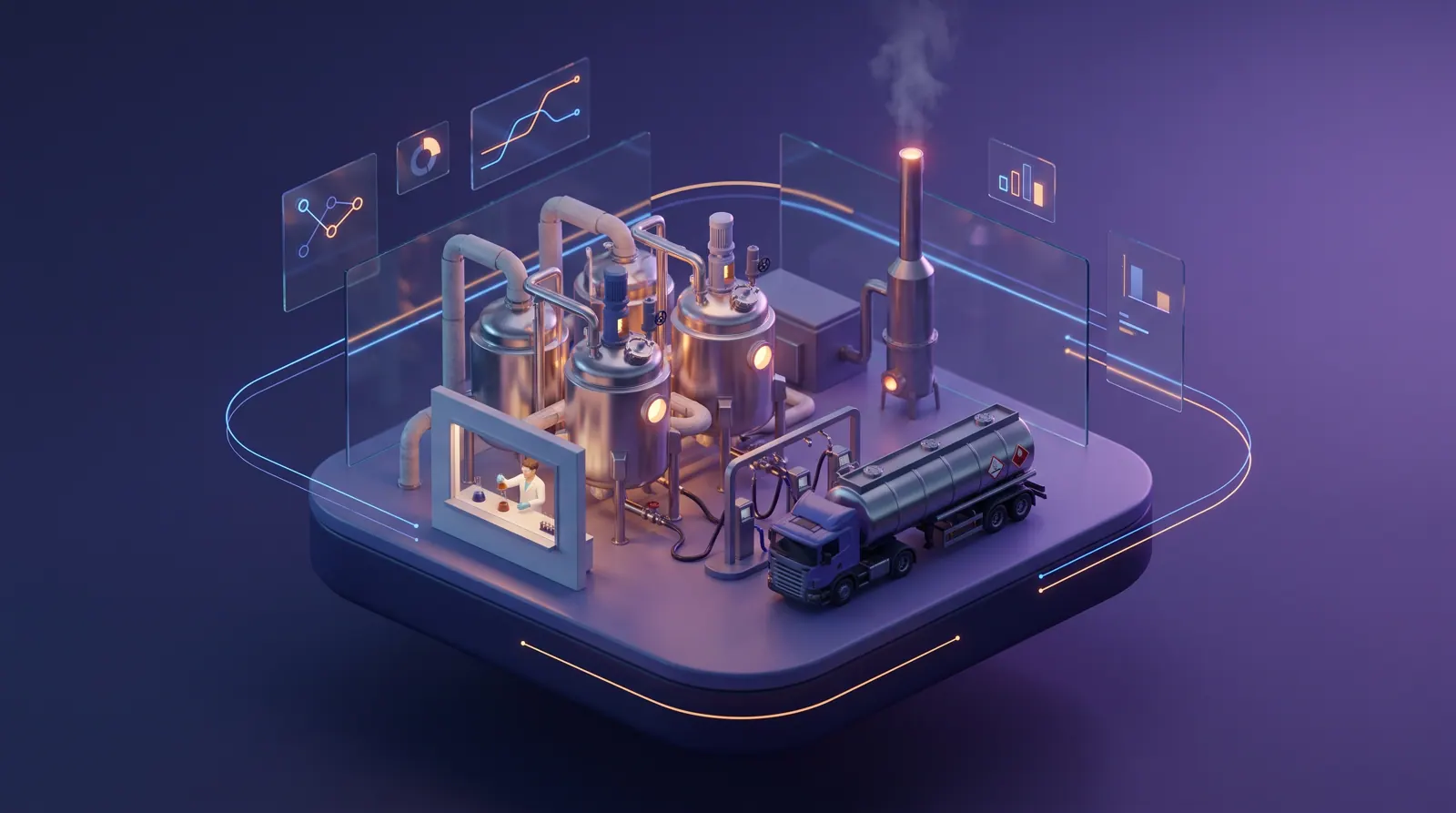
Chemical plant with reactors, a QC lab bench, a placarded tank truck at the loading rack and an oxidizer stack
ManufacturedOps(opens ManufacturedOps in a new tab)LabsOfScience(opens LabsOfScience in a new tab)AssetHandler(opens AssetHandler in a new tab)EcoImpactHub(opens EcoImpactHub in a new tab)CrewFoundry(opens CrewFoundry in a new tab)BuildMyIQ(opens BuildMyIQ in a new tab)MoveTheWheels(opens MoveTheWheels in a new tab)Botlit(opens Botlit in a new tab)

The problem

Why running a chemical site is hard right now

Batch results, customer specifications, inspection dates, procedure training, shipping papers and permit readings live in separate records, so problems surface late and evidence is rebuilt by hand.

Most specialty and industrial chemical, coatings and fertilizer sites run on a patchwork. Batch tickets travel on paper, QC results sit in a lab spreadsheet or an aging laboratory system, customer specifications live in sales folders, relief valve and vessel due dates come from a contractor's list, change reviews are forms in a binder, safety data sheets sit on a shared drive and permit readings in the environmental coordinator's spreadsheet. Each record is right about its own slice and blind to the rest.

The pressure comes from every direction. Customers expect certificates of analysis against their own specifications and fast, evidence-backed answers when something goes wrong. Process safety programs, insurers and regulators expect inspection dates kept, changes reviewed before start-up and operators trained on the current procedure. Hazardous shipments must carry the right documents and placards. Thermal oxidizers, scrubbers and, on fertilizer sites, nitrous oxide abatement are tied to permit conditions. Experienced operators are retiring, and margins on many grades leave little room for sprawling enterprise suites.

This page describes a solution concept: how specialist Burdenoff products are designed to pass facts about batches, equipment, people, loads and permits to one another on Burdenoff Workspaces. The products are pre-launch, and the hand-offs shown here describe how they are designed to work together.
Who this is for

  • Site or plant manager

    Hitting the batch plan and ship dates with reactors, crews and permits in order, and hearing about problems before the morning meeting.

  • QA and QC manager

    Releasing batches on complete evidence, certificates that match each customer's specification, and a recorded decision for every off-spec batch.

  • EHS and process safety manager

    Relief valves and vessels inside their inspection dates, changes reviewed before start-up, and abatement outages reported on time.

  • Logistics and dangerous goods coordinator

    Hazardous loads leaving with the right shipping papers, correct placards, allowed mixes, the current SDS for the customer and a cleared driver.

  • Production and training lead

    Operators trained on every changed procedure before start-up, with proof of who passed the check on which revision.

  • Technical service manager

    Fast answers from approved data sheets, and complaints investigated with the lot history and a retained-sample re-test.

A day in the life

The story behind the solution

A Tuesday at Calder Point Resins

Farah runs day-to-day operations at a site with two reactor trains, a solvent tank farm, a drum and tote filling hall and a tank-truck loading rack. Her Tuesday starts with an off-spec batch and ends with a customer complaint the next morning. Each chapter below sets up one of the problems this page is about; the people, products and plant are invented.

  1. Tuesday, 5:40 a.m.

    Batch B-2417 comes back thick

    The overnight QC results for B-2417, 12 metric tons of alkyd resin AR-560, land in the lab spreadsheet: viscosity is above the upper limit and acid value is close to it. Shift chemist Ivan Petrov wants to add mineral spirits and re-test. A tanker is booked for Wednesday at 6:00 a.m. for a customer whose acid value limit is tighter than the standard grade. Farah cannot see, in one place, which customers the batch would still meet, or who signs off an adjustment.

    How this is solved: Release good batches fast, and give off-spec ones a recorded path
  2. Tuesday, 9:15 a.m.

    Three loads, three paperwork problems

    Shipping coordinator Rosa Delacroix is building the hazardous loads for the next 24 hours. A mixed trailer has drums of thinner planned beside totes of an oxidizing etch cleaner, which site rules keep on separate vehicles. The resin solution going out by tank truck still has last month's safety data sheet attached for the customer, and driver Joel Mensah's hazardous materials endorsement runs out in two days. Rosa finds the first problem by luck and the other two by phone.

    How this is solved: Ship hazardous loads with the right papers, placards and driver
  3. Tuesday, 11:00 a.m.

    A relief valve three weeks overdue

    Reliability engineer Kenji Watanabe notices that PSV-2104, the relief valve on reactor R-2, is three weeks past its twelve-month bench test, with no deferral on record. Pulling it needs R-2 empty, and the schedule has two resin campaigns back to back. The solvent header's thickness readings sit in a contractor's report, and a gasket material change on R-2's bottom valve is still waiting for its management-of-change review. Kenji spends the afternoon reconciling three spreadsheets.

    How this is solved: Keep relief valves, vessels and piping inside their inspection dates
  4. Tuesday, 2:00 p.m.

    A changed procedure and a start-up at six

    Revision 7 of the R-2 charging procedure clears its management-of-change review, with a new charge sequence and an added hold point. The next R-2 batch starts on it at 6:00 p.m., and the pre-startup safety review cannot be signed until every affected operator is trained. Walking the floor at 5:00 p.m., night lead Oksana Bilyk learns that two of her four reactor-floor operators have not been through the change, and a panel operator's sign-off is on paper in a drawer. She has an hour to close the gap or hold the start-up.

    How this is solved: Hold start-up until every operator is trained on the changed procedure
  5. Tuesday, 5:30 p.m.

    The oxidizer trips mid-strip

    The thermal oxidizer that treats reactor vent gas trips on low combustion temperature while R-1 is stripping solvent from batch B-2419. It is back in forty-two minutes, but the times stay on a panel screen, not on the batch. An hour earlier the wastewater pH probe read out of range. Environmental coordinator Samuel Osei will find both in the morning log, with a deviation report due Friday and three waste drums near their storage time limit.

    How this is solved: Tie every abatement outage to its batches and its report date
  6. Wednesday, 8:10 a.m.

    Peeling primer at a customer's shop

    A distributor writes in the chat channel: panels sprayed with epoxy primer EP-240, lot 24-0917, are peeling at the edges. In the same queue sit a recoat-window question, a request for the current safety data sheet and a storage question. Technical service chemist Leah Brandt needs the lot's certificate, batch record, retained sample and the list of other customers who received it, which means three systems and a walk to the retain room.

    How this is solved: Answer customer questions and complaints from the batch record

None of these problems is unusual on a chemical site. What changes in this concept is that each one surfaces where the responsible person works, with the batch, the equipment, the people and the permit already linked, so Farah's morning meeting starts from records rather than recollection.

Challenges and how they are solved

6 problems, several products, one connected answer

Each challenge shows the problem as it happens, how the products are designed to hand work to each other, and the concepts that illustrate it. Share any challenge on its own.

Answers are in plain business terms. Choose Technical, or open any technical detail, to see how it works under the hood.

The problem

At 5:40 a.m. the QC lab posts results for batch B-2417, 12 metric tons of an alkyd resin: viscosity is above the upper limit and acid value sits close to it. The shift chemist wants to add solvent and re-test; the site manager wants to know whether Wednesday's tanker can still go. The charge weights are on a paper traveler, the results in a lab spreadsheet and the customer specifications for the grade in a sales folder. Nobody can see in one place which customers the batch meets as it stands, what an adjustment would change or who approved it.

What it costs

Off-spec batches sit in tanks and tie up capacity, adjustments go unrecorded, and a certificate of analysis can go out against the wrong specification, which is where complaints often begin.

How the products work together

ManufacturedOps is designed to put the lab's results from LabsOfScience on the batch record and check them against every customer's specification. When a batch misses, the shift chemist sees which customers it still suits and what an adjustment would change, and records the fix and the re-test. Quality then releases or holds the batch with all the evidence, including equipment checks from AssetHandler, on one screen.

How it works — technical detail

Technical detail

LabsOfScience holds each QC test method as a versioned protocol frozen at publish, records every result as a numbered run under it and keeps the analyst's signed notebook entry, so a viscosity or acid value cites the method version behind it. ManufacturedOps is designed to bring those results onto the batch record beside quantities, material lots, holds and non-conformances, with equipment calibration status from AssetHandler, and to lay them against the standard and each customer-specific specification for the grade. When a result fails, the off-spec view, built on the non-conformance record, lists the paths (adjust and re-test, blend, re-grade, rework), shows the predicted effect of an adjustment and records the approver and reason. An approved adjustment is added to the production order as an operation, the re-test goes back to LabsOfScience as a new run, and QA releases with the evidence on one screen.

The outcome it is designed for

Every batch leaves with a decision that names its results, method versions, adjustments and approver, and off-spec material has a recorded path instead of a parked tank.

The concepts behind it

The problem

At 9:15 a.m. the shipping coordinator is building the loads for the next 24 hours: a tank truck of solvent blend at the rack, a tank truck of resin solution, and a mixed trailer with drums of thinner and totes of an oxidizing cleaner. She builds each bill of lading from a template, prints safety data sheets from a shared drive and checks drivers' hazardous materials endorsements by phone. The resin solution's SDS was revised last month and the old revision is attached for the customer. Nobody has checked the site's segregation rules for the mixed trailer. A fertilizer producer loading ammonium nitrate faces the same checks.

What it costs

A wrong SDS revision, a missing placard or a forbidden mix on one trailer can stop a load at the gate or on the road, and puts drivers and customers at risk.

How the products work together

Before any paperwork prints, MoveTheWheels is designed to check each hazardous load: the right hazard details and placards, the current safety data sheet for the customer, which products may share a trailer, and whether every batch on it is released. CrewFoundry is designed to track drivers' hazardous materials endorsements, so MoveTheWheels can flag a driver who is not cleared.

How it works — technical detail

Technical detail

MoveTheWheels is designed to treat each outbound load as a dangerous-goods record: every line carries its UN number, proper shipping name, hazard class, packing group, packaging and lot number, and the shipment holds the SDS revision sent to the customer. Before the bill of lading is released, a readiness check compares that SDS with the current revision, applies the site's configured segregation rules to lines sharing a vehicle, lists the placards required and confirms each lot is released in ManufacturedOps. CrewFoundry is designed to hold drivers' hazardous materials and tanker endorsements, medical certificates and training beside the roster (shift rosters are on its roadmap) and to mark a driver whose endorsement is about to lapse as not dispatchable, so MoveTheWheels can flag the load. A failed check blocks the paperwork and names the fix, and a rack-side check on a phone records placards, seals and the shipping papers in the cab.

The outcome it is designed for

Hazardous loads leave with matching placards, the right shipping papers and a cleared driver, the customer gets the current SDS, and every check sits on the shipment record.

The concepts behind it

The problem

At 11:00 a.m. the reliability engineer finds that the relief valve on reactor R-2 is three weeks past its twelve-month bench test, with no deferral recorded. The valve can only be pulled when R-2 is empty, and the schedule has two resin campaigns back to back. Thickness readings for the solvent header live in a contractor's report, the vessel inspection due list is a spreadsheet, and a gasket material change on R-2's bottom valve is waiting for a management-of-change review nobody has chased. Each gap is known to someone; none is visible to everyone.

What it costs

Overdue relief valve tests and unreviewed changes are exactly what process safety audits and insurers ask about, and an unplanned stop to catch up can cost a whole campaign.

How the products work together

AssetHandler is designed to keep one list of every relief valve, vessel and pipe run with its next inspection, latest wall-thickness reading and any change awaiting review, and to record a risk review for anything overdue. It is also designed to check the reactor schedule in ManufacturedOps so the work lands between campaigns, while CrewFoundry lines up fitters and inspectors whose certificates are current.

How it works — technical detail

Technical detail

AssetHandler is designed to hold the site's pressure equipment (relief valves, vessels, exchangers and piping circuits) as assets with inspection intervals, last results and thickness readings at each monitoring location, from which the integrity board is designed to work out a corrosion rate and remaining life. The board ranks what is overdue or trending toward retirement thickness and shows open change requests, which a site can use to record management-of-change reviews, against the same equipment. An overdue item is designed to require a recorded deferral with a risk review until the pull is done. The board is designed to read the reactor campaign schedule from ManufacturedOps, so a valve pull is booked into the clean-out between campaigns. Work that needs a shutdown is gathered into a work pack designed to pass to CrewFoundry, which matches each job to fitters, inspectors and permit issuers with current tickets.

The outcome it is designed for

Relief valve tests, vessel inspections and thickness surveys are planned into real production windows, overdue items carry a recorded deferral, and every open change sits beside the equipment it touches.

The concepts behind it

AssetHandler

Pressure Relief Valve and Vessel Inspection Board

Ranks relief valves, vessels and piping circuits by inspection due date and thickness trend, with deferrals, open changes and the next clean-out window beside each item.

Works with ManufacturedOps, CrewFoundry

The problem

At 2:00 p.m. revision 7 of the R-2 charging procedure clears management of change (MOC), with a new charge sequence and an added hold point. The next R-2 batch starts on it at 6:00 p.m., and the pre-startup safety review (PSSR) must confirm that every affected operator is trained before it does. Two of the four night-shift reactor-floor operators have not been through the change, and a board operator's sign-off is on paper in a supervisor's drawer. The PSSR training line is a signature, not a record of who learned what. The night lead finds out walking the floor at 5:00 p.m., with an hour to go.

What it costs

Starting a changed procedure with operators who have not learned it is a known path from a routine batch to an incident, and a pre-startup review signed on assumption is what an incident review looks at first.

How the products work together

When a procedure changes, ManufacturedOps is designed to hold the first batch on it until every affected operator has passed a short check on what changed. BuildMyIQ gives the check and records who passed, and CrewFoundry shows who is qualified on the new version, so the pre-startup safety review is signed on records, not assumptions.

How it works — technical detail

Technical detail

When MOC approves revision 7, ManufacturedOps is designed to hold it as a versioned work instruction linked to the R-2 charging operation, and to keep the first production order on revision 7 on hold until the PSSR shows every affected operator has passed. ManufacturedOps passes the revision and the stations named in the shift's production orders; CrewFoundry passes the operators whose recorded skills cover those stations; BuildMyIQ assigns a short check on what changed (the new charge sequence, the new hold point) and returns pass results by operator. BuildMyIQ fits this step because its questions are scored against an answer key kept on the server, with a passing score and attempt limit. The results are designed to fill the PSSR training line and CrewFoundry's record of who is qualified on revision 7; shift rosters and cover suggestions are on CrewFoundry's roadmap.

The outcome it is designed for

No changed procedure starts until the operators running it have passed a check on that revision, and the pre-startup review shows who was trained, when and on which version.

The concepts behind it

The problem

At 5:30 p.m. the thermal oxidizer that treats reactor vent gas trips on low combustion temperature while reactor R-1 is stripping solvent. An operator restarts it forty-two minutes later, but the start and end times stay on a panel screen, not on the batch that was venting. An hour earlier the wastewater pretreatment pH probe read out of range. The environmental coordinator learns about both from the morning log, with a deviation report due within days and three hazardous waste drums approaching their accumulation time limit. A fertilizer site has the same gap when a nitric acid plant's nitrous oxide abatement is bypassed during a start-up.

What it costs

Late deviation reports, unexplained exceedances and overdue waste containers draw regulators' attention, and rebuilding the facts from memory is slow and unreliable.

How the products work together

EcoImpactHub is designed to check each permitted stack and discharge point against its limits as readings are recorded. When the oxidizer trips, it logs the outage, which batches were venting and when the report is due, and it tracks waste drums against their time limits. AssetHandler takes the repair and shows which equipment uses the most energy.

How it works — technical detail

Technical detail

EcoImpactHub is designed to model each permitted point (the oxidizer stack, the scrubber, the wastewater outfall) as a monitored site with permit thresholds, and to check readings against them as they are recorded, so a low combustion temperature or an out-of-range pH raises a breach at the right severity. Automatic sensor ingestion is on its roadmap, and triage of probe faults is a target experience. The abatement downtime log records each outage's start and end, the batches venting as reported by ManufacturedOps, an excess-emissions estimate with its method and the report due date; a waste tab tracks each container's accumulation start. The repair is designed to pass to AssetHandler as a work order against the oxidizer, and AssetHandler's sustainability view, built on EcoImpactHub metrics, is designed to rank energy use by asset beside the site's emissions trend.

The outcome it is designed for

Every abatement outage and permit exceedance has a start time, a cause, the batches involved and an owner, and the deviation report starts from records rather than memory.

The concepts behind it

EcoImpactHub

Abatement Downtime and Permit Deviation Log

Logs each oxidizer, scrubber, nitrous oxide abatement or outfall event with its limit, duration, batches venting, excess estimate, repair and report due date, plus waste container clocks.

Works with ManufacturedOps, AssetHandler

The problem

At 8:10 a.m. on Wednesday a distributor writes: an industrial customer says panels sprayed with epoxy primer lot 24-0917 are peeling at the edges. The same queue holds a recoat-window question at low temperature, a request for the current SDS and a storage question. To answer the complaint, the technical service chemist needs the lot's certificate of analysis, its batch record, the retained sample and the list of other customers who received the same lot, which means three systems and a walk to the retain room while the distributor waits.

What it costs

Slow or unsupported answers cost repeat orders, and a complaint closed without evidence can hide a batch problem that is already at other customers.

How the products work together

Botlit is designed to answer routine customer questions from your approved technical and safety data sheets and pass complaints to technical service with the batch number attached. ManufacturedOps and MoveTheWheels are designed to show where that batch came from and which customers received it, and LabsOfScience records the re-test of the kept sample, so the reply rests on evidence.

How it works — technical detail

Technical detail

Botlit is designed to run a technical service desk for distributors and customers on messaging channels, answering routine questions only from approved technical and safety data sheets, citing the document and section, and handing complaints, formulation questions and anything about exposure to a person with the product, lot number and symptom attached; cited answers and hand-off to people are on its roadmap. ManufacturedOps genealogy (in progress) is designed to trace lot 24-0917 back to its raw-material lots and batch record; MoveTheWheels shipment records, designed to carry lot numbers, are designed to list every customer that received it. The chemist opens the investigation in LabsOfScience as an experiment and records the retained-sample re-test and application panels as numbered runs; the result decides whether the case becomes a non-conformance with corrective action in ManufacturedOps.

The outcome it is designed for

Routine questions get cited answers at any hour, and every complaint reaches a chemist with the lot history, the customers who received it and the re-test in one case.

The concepts behind it

How it fits together

How it fits together from reactor clearance to the customer's question

Follow one batch's journey through the products. Each step is one product doing its part and handing a concrete record on to another product; the hand-offs show how the products are designed to work together. EcoImpactHub works alongside the run, logging any abatement outage against the batches venting at the time.
  1. To ManufacturedOps: the reactor's status and the booked valve work

  2. To CrewFoundry: who passed the check on the new procedure

  3. To ManufacturedOps: who is cleared to run the new procedure

  4. To LabsOfScience: batch samples and the tests the grade needs

  5. To ManufacturedOps: test results that decide release or rework

  6. To MoveTheWheels: which batches are released to ship

  7. To Botlit: what shipped, which batches and which safety data sheet

Step 1 of 8: Clear the reactor

How each hand-off works — technical detail

Technical detail

  1. 1. AssetHandler — Clear the reactor: Is designed to confirm the reactor's relief valve tests, vessel inspections, deferrals and open change requests, and book due work into the next clean-out window.Hands to ManufacturedOps: Equipment status for reactor R-2, with any deferral and the valve pull booked into the clean-out
  2. 2. BuildMyIQ — Check the changed procedure: Is designed to assign a short check on each procedure revision to the operators it affects and record each result against the revision.Hands to CrewFoundry: Pass results by operator for revision 7 of the R-2 charging procedure
  3. 3. CrewFoundry — Confirm who is qualified: Is designed to record which operators are qualified on the current procedure for each station and flag sign-offs that are about to expire.Hands to ManufacturedOps: Operators qualified on revision 7, for the pre-startup safety review
  4. 4. ManufacturedOps — Run the batch: Runs the production order and records quantities, material lots, holds and non-conformances, and is designed to log vent periods against the batch.Hands to LabsOfScience: Batch samples with the grade's test plan and customer specifications
  5. 5. LabsOfScience — Test to method: Records each QC result as a numbered run under a frozen test method, with a notebook entry signed by the analyst.Hands to ManufacturedOps: Results citing method versions, which decide release or disposition
  6. 6. ManufacturedOps — Release the batch: Is designed to lay the results against every customer specification and release the batch, hold it or send it to off-spec disposition.Hands to MoveTheWheels: Released lots, ready to be loaded
  7. 7. MoveTheWheels — Check the hazardous load: Is designed to check each load for UN details, placards, segregation, the current SDS, released lots and a driver CrewFoundry shows as cleared before papers print.Hands to Botlit: Shipment record with lot numbers and the SDS revision sent to the customer
  8. 8. Botlit — Answer the customer: Is designed to answer routine questions from approved technical and safety data sheets with citations, and hand complaints to technical service by lot.Hands to ManufacturedOps: Complaint case with product, lot number and symptom, for lot tracing and a re-test

Products in this solution

What each product brings

  • ManufacturedOps

    Batch execution, quality release and lot history

    Designed to run production for plants of many kinds, chemical plants included: batch orders, quality checks and corrective actions. Lot history is in progress, and certificates of analysis are on its roadmap.

    Technical detail

    Technical detail

    Designed as a modern execution system for discrete and process plants, chemicals included: production orders and routings, inspections, SPC, NCR and CAPA, material lots with genealogy in progress, work instructions and maintenance. Certificates of analysis are on its roadmap.

  • LabsOfScience

    QC methods, results and retained-sample re-tests

    Keeps each lab test method in fixed versions, records every result with who ran it, lets analysts sign and witness notebook entries, and tracks lab chemicals and instrument bookings, which suits a quality control and application lab.

    Technical detail

    Technical detail

    Holds test methods as versioned protocols frozen at publish, results as numbered runs, notebook entries that are signed and witnessed, checksummed data versions, and reagent inventory with safety data sheets and instrument booking, which suits a QC and application lab.

  • AssetHandler

    Pressure equipment integrity and repairs

    Is designed to keep one list of every relief valve, vessel, pipe run and piece of pollution-control equipment, with inspection schedules, repair jobs and changes waiting for review.

    Technical detail

    Technical detail

    One registry for every asset with preventive schedules, work orders, an audit trail and change requests a site can use to record management-of-change reviews (approval workflows are on its roadmap); its sustainability metrics come from EcoImpactHub.

  • EcoImpactHub

    Permit monitoring, abatement events and emissions

    Is designed to check stack and discharge readings against their limits as they are recorded, flag breaches at the right urgency and keep the site's carbon accounts. Tracking permits and waste is on its roadmap.

    Technical detail

    Technical detail

    Models facilities as monitored sites with sensors, thresholds at info, warning and critical severity and a Scope 1, 2 and 3 carbon ledger; AI triage of sensor faults is a target experience, and permits, waste tracking and automatic sensor ingestion are on its roadmap.

  • CrewFoundry

    Operator, driver and turnaround crew qualifications

    Keeps each operator's and driver's skills and certificates in one place; shift rosters that show gaps before a shift are on its roadmap.

    Technical detail

    Technical detail

    A people platform with skills attached to people, certificates and a learning workspace; a shared skills graph is in progress and shift rosters are on its roadmap.

  • BuildMyIQ

    Checks on changed procedures

    Builds short checks and courses, scores them and issues certificates, which suits checking that operators understood a changed procedure.

    Technical detail

    Technical detail

    A learning platform with course authoring, typed assessments whose answer keys stay on the server, passing scores and attempt limits, auto-grading of objective questions and verifiable certificates, suited to short checks on changed operating procedures.

  • MoveTheWheels

    Hazardous shipments, documents and where each lot went

    Plans and tracks every outbound load and assigns drivers and vehicles, and is designed to keep bills of lading with the shipment, which is where a hazardous-load check belongs. Electronic delivery proof is on its roadmap.

    Technical detail

    Technical detail

    A logistics control tower with orders, shipments, fleet and driver registers and dispatch, with bills of lading and other shipment documents designed to live on the shipment record; electronic proof of delivery is on its roadmap.

  • Botlit

    Customer technical service desk

    Is designed to run assistants that answer from your approved documents on messaging channels, follow set rules and hand the rest to people; several of these parts are on its roadmap.

    Technical detail

    Technical detail

    Agents with knowledge bases, channel connectors for WhatsApp, Teams and Slack, stored content policies, routing between agents and a run ledger; cited answers from those documents, run-time policy enforcement, a web chat widget and hand-off to people are on its roadmap.

    Visit BotlitAll concepts

One platform underneath: Burdenoff Workspaces

Burdenoff Workspaces is the shared foundation: one sign-in for chemists, operators, engineers and coordinators, role-based access so each person sees what their role allows, one audit trail across batch, lab, equipment, shipping and permit records, and one bill across the products.

Concept gallery

Every concept in this solution

15 concepts from 8 products. Each one links to its own page on the product's website, and every view has a link you can share.

Pitch kit

The Chemicals solution in one minute

Chemical sites run on paper travelers, lab spreadsheets, inspection lists, SDS folders and permit logs that never meet. Burdenoff is designed to connect specialist products on one workspace: ManufacturedOps and LabsOfScience for batch release, AssetHandler for pressure equipment, BuildMyIQ and CrewFoundry for trained operators, MoveTheWheels for hazardous loads, EcoImpactHub for permits and Botlit for technical service.

  • Release batches against every customer specification, with off-spec adjustments and re-tests on the record
  • Hold a changed procedure's start-up until every affected operator has passed a check on it
  • Check each hazardous load for placards, segregation, the current SDS and a cleared driver before papers print
  • Plan relief valve tests and vessel inspections into real clean-out windows, with deferrals and open changes in view
  • Log abatement outages against the batches venting, and route customer complaints to a chemist with the lot history
Email it

Questions

Frequently asked

Do we have to replace our ERP or laboratory system?

No. ManufacturedOps is designed to sit between your business system and the plant floor, and your business system stays the home for finance and customer orders. LabsOfScience can start with the lab tests that decide release, and you can decide later how results from an existing lab system should come in.

Technical detail

Technical detail

No. ManufacturedOps is designed to sit between the ERP and the plant floor; its current pre-launch build includes an API and one accounting-system connector that exchanges inventory items both ways, and order and BOM sync are on its roadmap. LabsOfScience holds test methods, runs and results behind its own API, so a site can start with the QC tests that decide release and decide later how results from an existing laboratory system should arrive. The ERP stays the system of record for finance and customer orders.

Will this make us compliant with process safety, dangerous goods or permit rules?

No. The products are designed to keep the records, due dates and checks your safety, shipping and environmental programs rely on, and to show gaps early. Your people and advisers stay responsible for meeting the rules, and the products hold no certifications.

Technical detail

Technical detail

No product can do that for you. These products are designed to keep the records, due dates and checks those programs depend on (inspection intervals, deferrals, change reviews, training by procedure revision, shipping details, permit readings) and to make gaps visible early. Your people, procedures and advisers stay responsible for compliance. The products hold no certifications ahead of launch, and EcoImpactHub is not a regulatory authority.

Can the customer-facing agent give safety or exposure advice?

No. It is designed to answer only from the data sheets you have approved and to name the section it used. Questions about exposure, first aid or spills go to a person, and the agent points to the emergency number on the safety data sheet.

Technical detail

Technical detail

No. The technical service agent is designed to answer only from the approved technical data sheets and safety data sheets in its knowledge base and to cite the section it used. Questions about exposure, first aid, spills or anything the documents do not cover are designed to go to a person, and the agent points to the emergency number printed on the SDS. Content policies are designed to set what it may and may not answer; cited answers and hand-off to people are on Botlit's roadmap.

Can we start with one reactor train or one problem?

Yes. Each product works on its own, so you can start with the problem that hurts most, such as batch release or inspection dates, and add the others later without setting up your people and their roles again.

Technical detail

Technical detail

Yes. Each product works on its own on Burdenoff Workspaces, so a site can start where the pain is sharpest, such as batch release with ManufacturedOps and LabsOfScience, or relief valve and vessel dates in AssetHandler, and add the other products later without re-entering people and roles, which Burdenoff Workspaces shares across products.

Can the customer desk carry our own brand?

No. Each product keeps its own name. You configure what matters: which of your data sheets the agent answers from, which channels it uses, what it may answer and when it hands over to your team. There is no custom development.

Technical detail

Technical detail

No. Botlit and the other products are offered under their own names; they are not rebranded. What you configure is the substance: the knowledge base of your technical and safety data sheets, the channels your distributors use, the questions the agent may answer and the rules for handing off to your technical service team. Configuration is built into the product; there is no custom development.

What is available today?

The products are pre-launch. Some parts shown here are built and others are on each product's roadmap, and the connections between products describe how they are designed to work together, not something you can switch on today.

Technical detail

Technical detail

The products are pre-launch. Each product's own page separates what is built from what is on its roadmap; for example, ManufacturedOps' material-lot genealogy is in progress and certificates of analysis are planned, CrewFoundry's shift rosters are planned, and EcoImpactHub's permit and waste tracking are on its roadmap. The industry views on this page and the hand-offs between products describe how they are designed to work together, not integrations you can switch on today.

Related domains

All domains

Want to explore this for your organization?

Tell us about your setup. We will walk you through the products involved and scope a pilot around the challenge that hurts most.

This is a solution concept: it shows how Burdenoff products are designed to work together in this industry. The images are illustrations of the concepts, not screenshots of the actual products, and every name and figure in them is sample data.